How to Choose Between the SAT and ACT
Everyone has an opinion about which test you should take. Your best friend says the ACT is easier. Your cousin swears the SAT is what Ivy League schools want to see. Your school counselor tells you to pick the one you prefer and go for it (and they aren’t wrong… but keep reading to find out why and how).
And you, most likely, don't want to take either one.
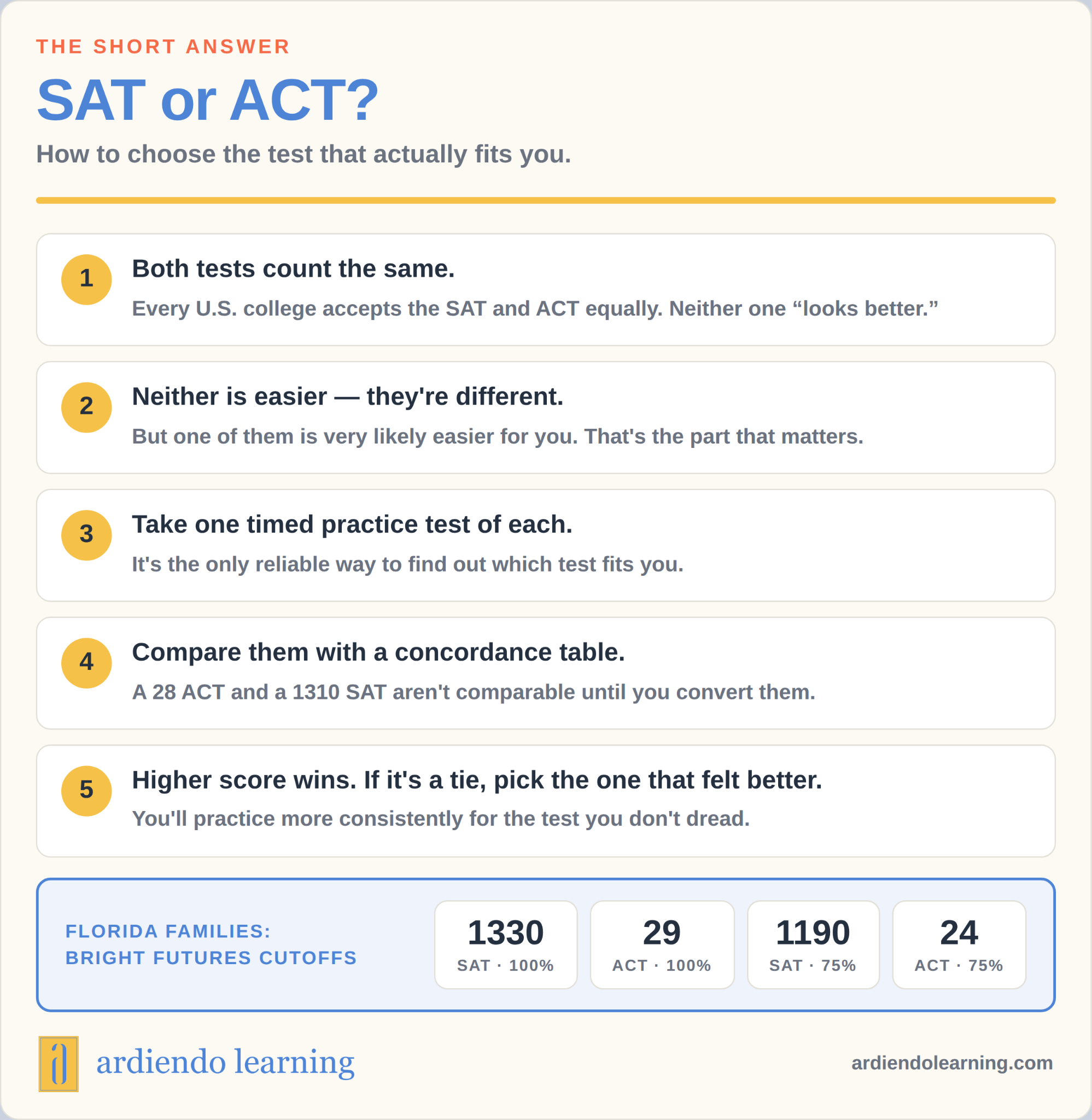
Here's why it's worth sitting with the decision anyway. In Florida, the gap between a 24 and a 29 is the difference between Bright Futures covering 75% and 100% of your tuition. Choosing the test you're stronger on can be worth thousands of dollars before you've answered a single practice question.
So let's build a system for choosing.
First, Let's Clear Up a Few Myths
Myth: Some colleges prefer one test.
They don't. Every college and university in the United States that accepts standardized test scores accepts the SAT and the ACT equally. There's no secret preference, no admissions advantage, no test that "looks better" on an application.
Myth: One test is easier than the other.
Neither test is easier. They're different — and those differences mean one of them is very likely easier for you. That's the distinction that actually matters.
Myth: Just pick one and start studying.
Take a practice test of each before you commit. You may score meaningfully higher on one without expecting to. And if your scores come out about even, choose the one you enjoyed more (yes, I know "enjoy" is a strange word to use about a three-hour standardized test). But there's a real difference between a test that feels like a fight and a test that feels like a puzzle, and you will practice more consistently for the one that feels like a puzzle.
(Tip: Use our ACT/SAT Score Converter to easily compare your scores for both tests on one scale.)
How the Tests Actually Differ
ACT/SAT Comparison
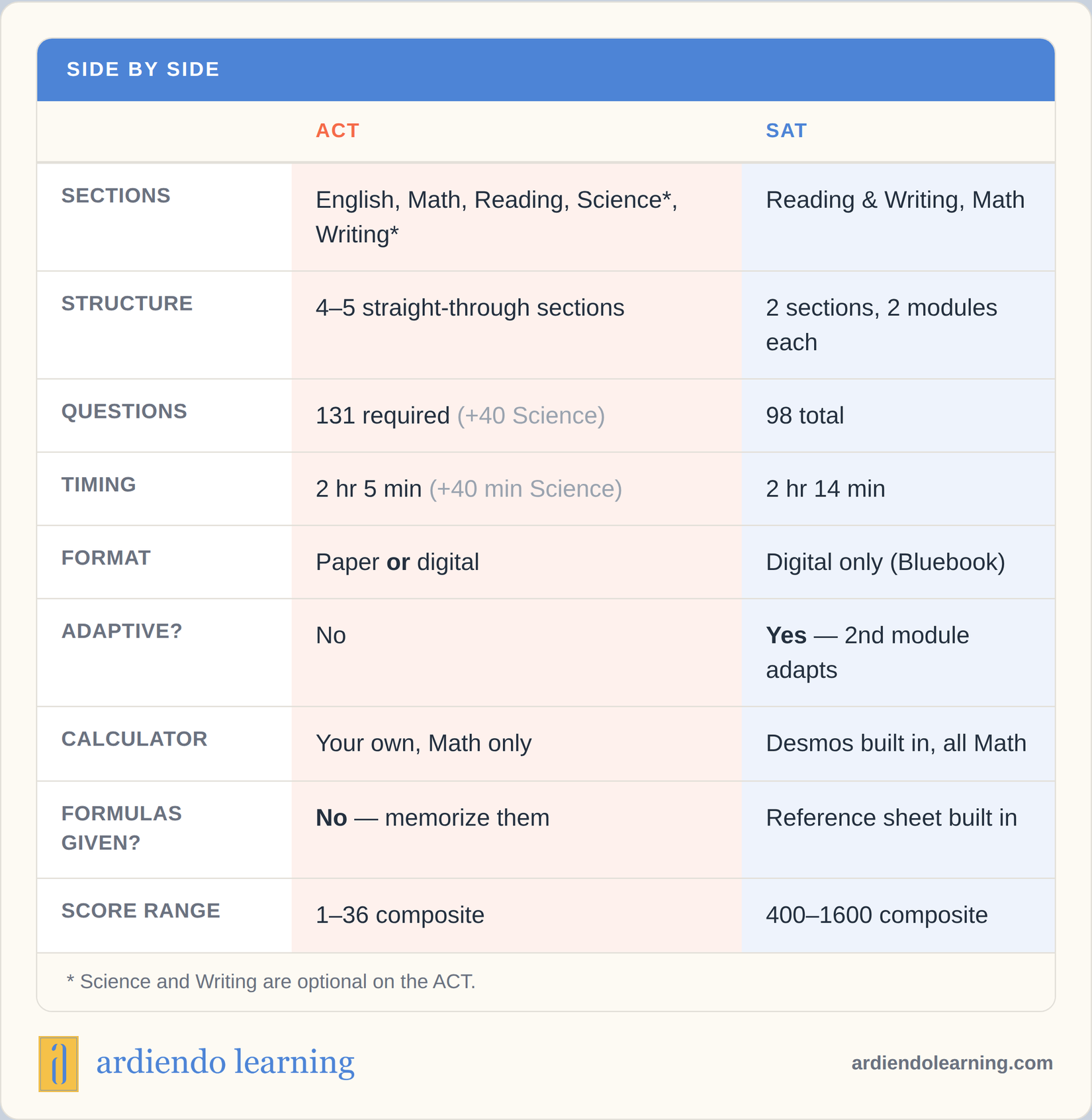
Side-by-Side Comparison for the ACT and SAT
Both the ACT and SAT have similar content, but formatting, length, and study regimen differ in meaningful ways.
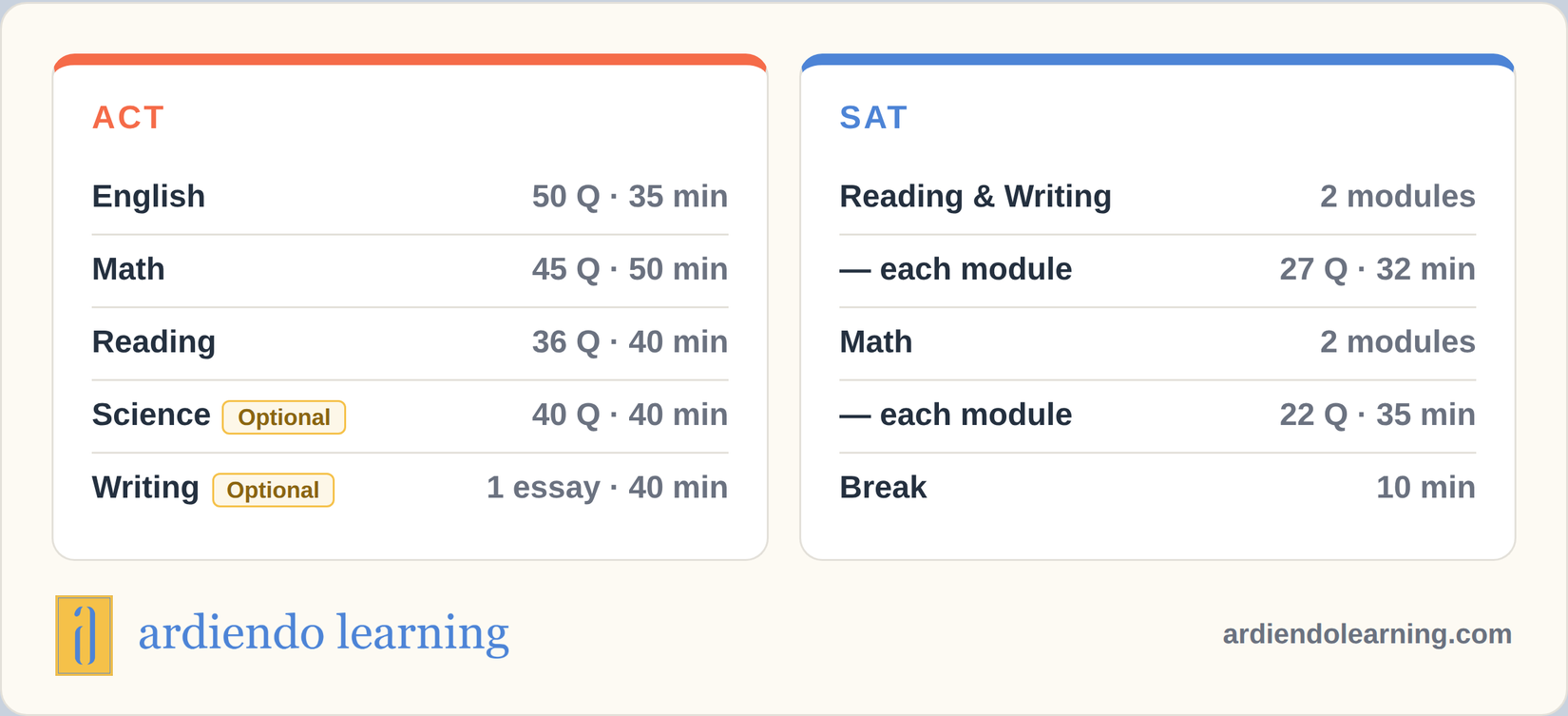
Length and scoring differ between the tests.
How They’re Scored
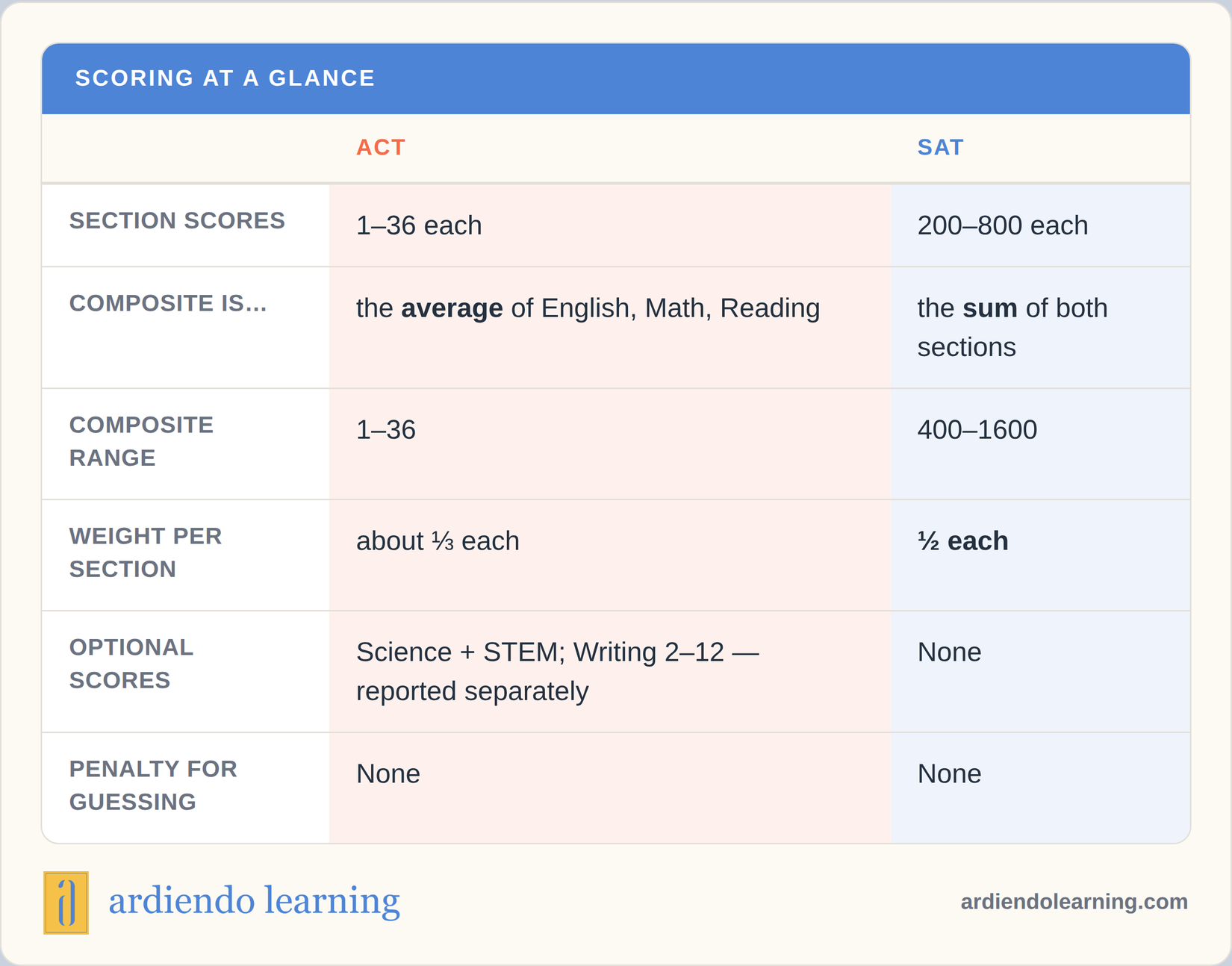
If you’ve already taken each test, you can use our score converter to see how they compare.
On the ACT, every section is scored 1–36, and your Composite is the average of English, Math, and Reading, rounded to the nearest whole number. As of September 2025, Science no longer counts toward the Composite except for specific circumstances when considering Bright Futures. If you take it, it's reported as its own section score alongside a STEM score for many universities. Writing, if you take it, is also scored separately and doesn't impact your Composite.
On the SAT, each of the two sections is scored 200–800, and your Composite is simply the two added together with a 400–1600 range.
Why this difference matters: The ACT averages three sections, so each one carries roughly a third of your Composite. The SAT adds two sections, so each one is a full half of your score. In practical terms, a single weak section costs you more on the SAT than it does on the ACT. If you are a strong reader, shaky on math, or the reverse, the ACT's third section can absorb some of that imbalance. If you're evenly strong across the board, the SAT gives you fewer places to lose points.
Neither test penalizes wrong answers. On both, an unanswered question and a wrong answer are worth exactly the same thing, so never leave a bubble blank!
The ACT in Practice
The ACT asks more questions and moves faster. You'll feel the pace.
English is a grammar section: punctuation, sentence structure, rhetorical skills, etc.
Math covers content through Algebra 2 with a bit of pre-calculus mixed in (the law of sines, for instance). The ACT does not give you a formula sheet, so you have to memorize your formulas.
Reading and Science both reward finding answers in the text. Science is less about science knowledge and oftentimes more about reading charts, graphs, and experimental setups efficiently. Both sections use long passages.
Science is now optional and is reported separately rather than folding into your Composite, except for Bright Futures, which is a nuanced calculation. Some colleges and scholarship programs still look at it, so check the schools on your list before you skip it.
A note on paper tests: the ACT still offers a paper version, and if you have access to it, I recommend it. Working on paper lets you annotate, cross out, draw, and physically move through the passage—you're offloading part of the thinking onto the page instead of holding it all in your head. For a test built on finding evidence in long passages, it can be incredibly helpful.
The SAT in Practice
Reading and Writing combines vocabulary in context, grammar, reading comprehension, logical reasoning, and scientific interpretation. Passages are short—usually a paragraph or two brief excerpts you're asked to compare. Every answer is findable in the text.
Math mixes multiple choice with student-produced responses (fill-in-the-blank), and Desmos is available throughout.
What is Bluebook?
Bluebook is College Board's testing application, which is the software you actually use to take the SAT. It's also used for the PSAT, several AP exams, and full SAT practice tests. It comes with a built-in Desmos graphing calculator, a reference sheet of common formulas, a countdown timer you can hide until five minutes remain, highlighting and annotation tools, an answer eliminator, mark-for-review flags, and a line reader.
There are two things worth knowing. First, the built-in reference sheet only covers foundational formulas. I still recommend memorizing them by understanding how the math works behind the formula. Also, the harder modules will ask for relationships that aren't on it, so you still have memorizing to do, anyway. Second, Bluebook is free, and you can take full official practice tests in it. I highly recommend practicing this way since practicing in the actual testing environment can remove a whole category of test-day stress.
What "Adaptive" Means
This is the piece most students don't understand, and it changes how you think about the test.
College Board describes the SAT as using a multistage adaptive design. In their words, each section "is divided into two equal-length, separately timed parts called modules," and "the questions you're given in the second module depend on how you performed on the first module." Based on your first-module performance, you're routed to a second module "which has a different mix of difficulty levels."
In plain terms: everyone takes the same first module. How you do on the section determines whether your second module is harder or easier.
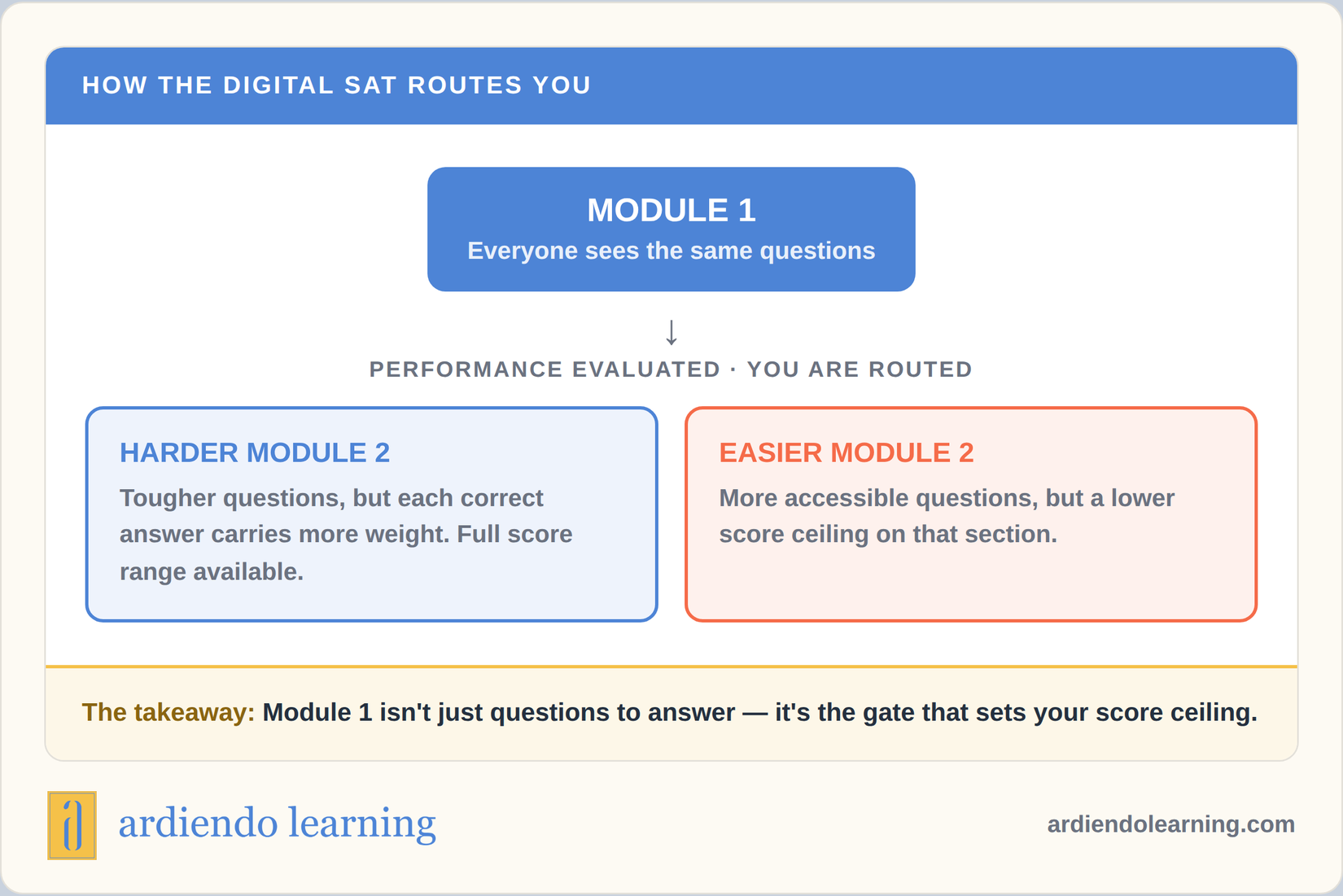
The test will change depending on how you perform in the first module, but it is unclear as to whether it is a “harder module” vs. “easier module” or specific questions that adapt. Taking a practice test will be the best way to find out.
College Board is careful to add that "no matter which module you're routed to, the most important thing to keep in mind is to do your best. Your score will be accurate, and you won't get a lower score just because you saw a lower difficulty set of questions."
It’s true that your score will accurately reflect your performance. When you do well on the first module, you get routed to the harder second module, and it feels awful sometimes. Students might walk out of the test certain they bombed it, and some of them start rushing or second-guessing themselves partway through because the questions suddenly got so much harder than what they just finished.
So if your second module feels brutal, take that as a good sign rather than a bad one. It means you did well enough on the first module to be routed to the questions that let you reach the top of the scale. The bigger risk on test day isn't the difficulty of that module. It's talking yourself out of it while you're still sitting there.
What that means for you: The first module is the highest-leverage part of the SAT. It's not just questions to answer; it's the gate that contributes to your score calculation. Take a deep breath, and do your best.
How the Tests Are Similar
The ACT and SAT are more similar than students expect.
Both reward understanding how the test itself works, including the question types, the traps, the patterns that repeat from form to form. Neither is a pure knowledge test.
Both test grammar at a similar level, drawing on largely the same rules.
Both demand stamina and pacing. You're sitting and concentrating for over two hours either way, and running out of gas in the last section is one of the most common ways students lose points.
Both require fluency with your calculator: Desmos or a graphing calculator (TI-84 Plus is recommended). Knowing your tool without hesitation is worth real points on either test.
Who Tends to Prefer Each Test
These are tendencies, not rules. Figure out what works best for you by reflecting on the tests themselves and how you learn best.
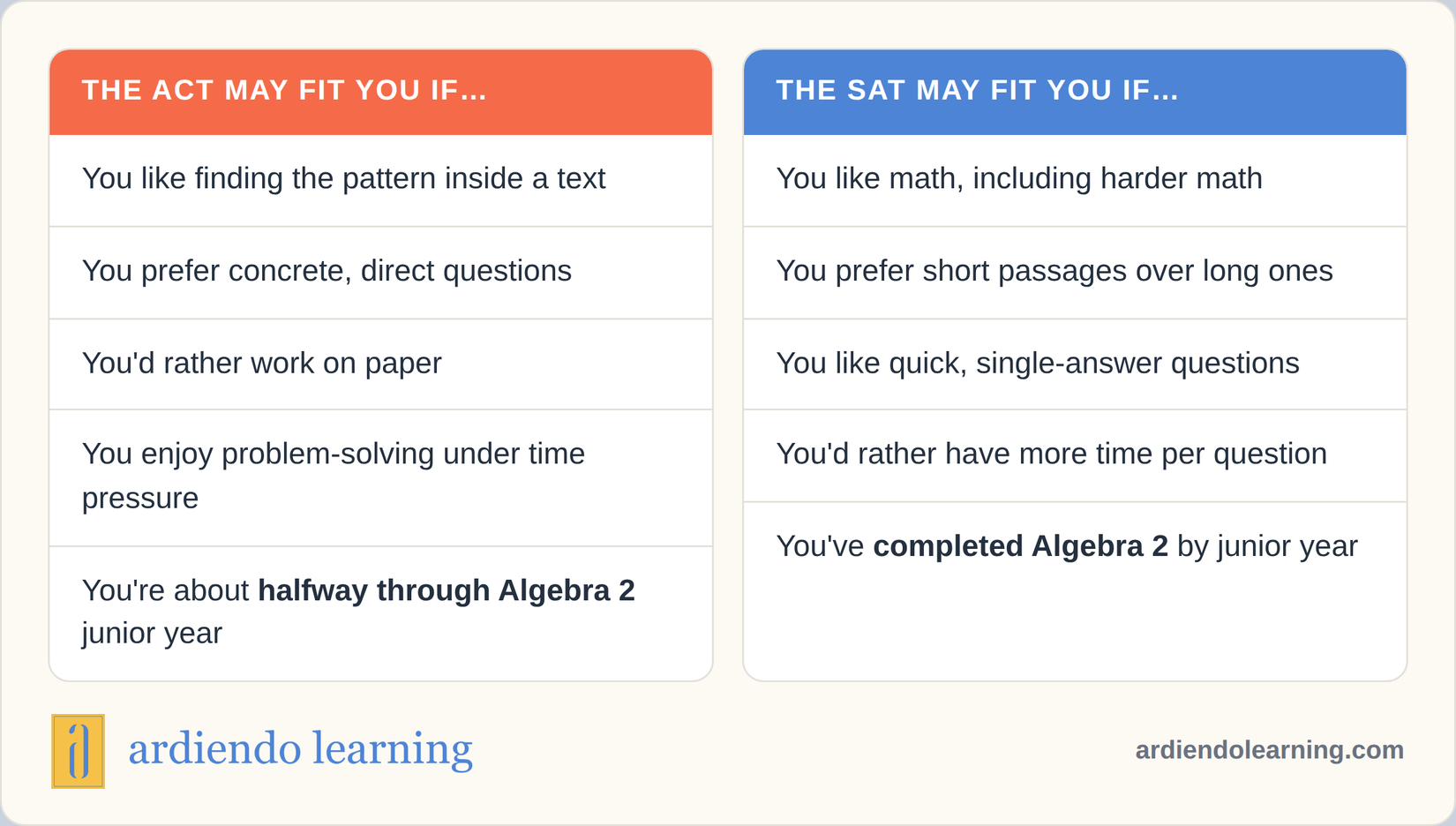
The timing of your math courses is important to consider when choosing a test. The SAT's harder module has more advanced material, so students who've finished Algebra 2 tend to have more room to progress through it. Students still working through Algebra 2 often find the ACT's broader-but-shallower math a better match for where they are right now. But this specific nuance and recommendation is best explored in a conversation with an equipped educator.
The Best Way to Choose
Take one of each, timed.
1. Sit for one full-length, timed ACT and one full-length, timed SAT (without your phone!). If you can sit for a real administration in the fall of your junior year, that’s even better. Nothing simulates test day like a real experience.
2. Compare the scores using a concordance table. A 28 on the ACT and a 1310 on the SAT aren't obviously comparable until you look them up. College Board and ACT publish official concordance tables that map one to the other.
3. Reflect on how each one felt–not just the score, but the experience. Which one felt less stressful? Where were you answering confidently versus guessing? Which one left you with time to think? Write it down while it's fresh.
What To Do With Your Results
If one score is meaningfully higher, take that test. Don't overthink it. If they're roughly equivalent, take the one that felt more natural and played to your strengths.
Then, pick one and practice consistently. Splitting your prep across both tests isn’t typically the best use of time.
One More Reason This Matters: Bright Futures
For Florida students, your test score isn't only about admissions. Bright Futures awards are tied to hard score cutoffs, and the difference between tiers is real money.
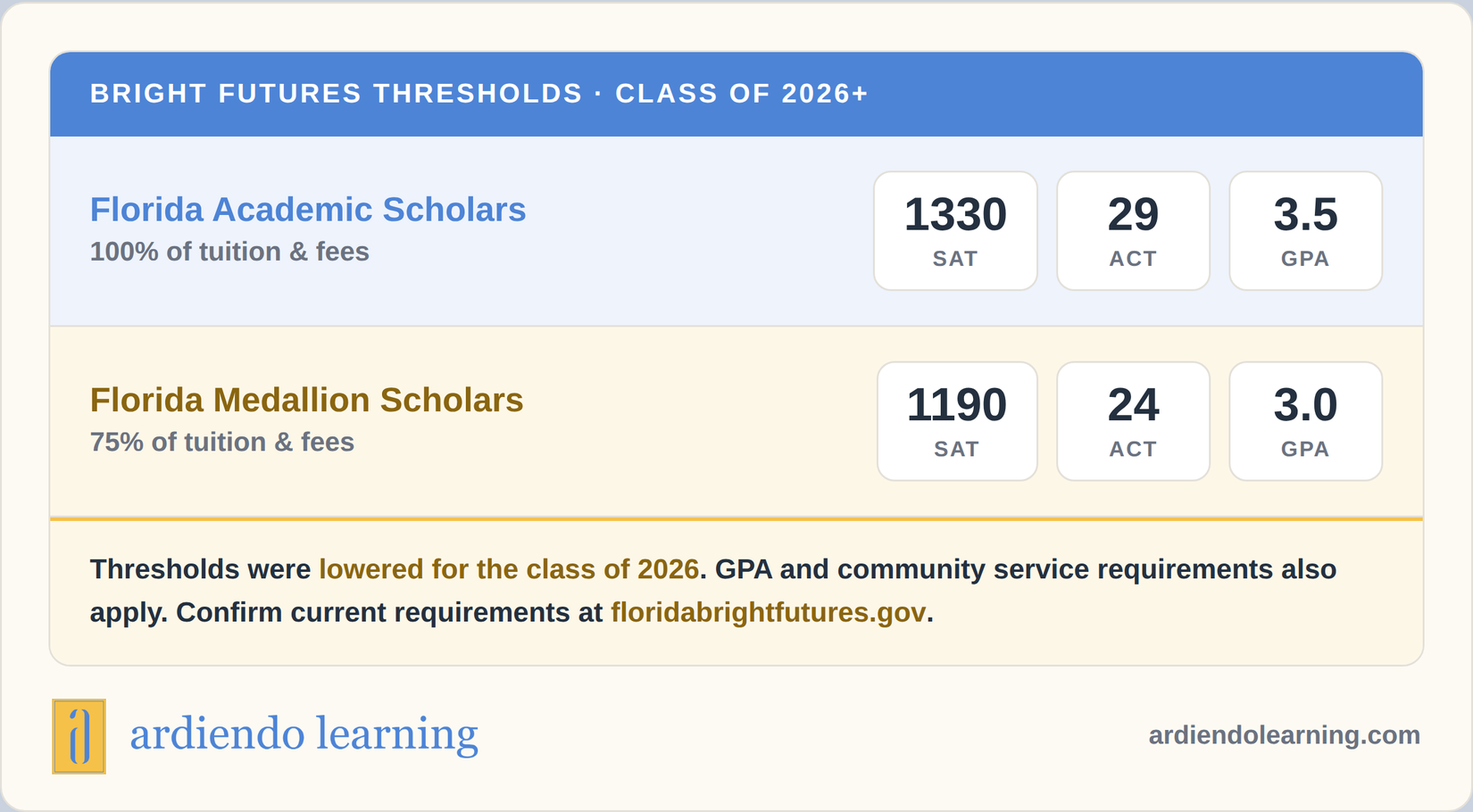
These thresholds were lowered for the class of 2026: FAS dropped from a 1340 SAT score and FMS from a 1210 SAT score (and from a 25 ACT score). Score requirements are only part of eligibility, however. There are also GPA and community service requirements, and the details change. Always confirm current requirements at floridabrightfutures.gov.
Notice what the concordance does here. If you're sitting at a 1290 on the SAT, you're 40 points from FAS. But if the ACT is genuinely your stronger test, a 29 gets you to the same place. Choosing the right test can be worth more than months of prep on the wrong test.
Where to Start
If you finished this and already know which test you should take, that’s great! Pick it and practice consistently.
If you don't know yet, that's what the practice tests are for.
And if you'd like help reading your results, comparing them honestly, or building a prep plan around whichever test is the best fit for you, we'd be glad to talk. Our initial consultations are always free, and you’ll leave with free recommendations and next steps regardless of whether you sign up for our Test Prep Coaching.