When Should You Start Preparing for the SAT or ACT?
Preparing for the SAT or ACT might seem like something you’re supposed to do, but it’s also important to understand why, when, and how you should prepare for these tests. If you haven’t started studying, don’t worry. We are here to help you understand why prepping for the SAT or ACT is important, when you or your student should start studying, and how they can create a study plan that works for them.
First, let’s start with what the SAT and ACT are…
These tests are standardized college entrance exams used to help universities gain a snapshot of how a student might perform on their campus. They are often one of three key metrics when applying to a university. For more exploration on the nuances of each test, check out this article: How to Choose Between the SAT and ACT
Now, why study for a test that changes every time you take it?
Studying for the SAT or ACT helps you prepare for how the test works and the content you need to understand. The test can be practiced, allowing you to become more and more efficient as you learn the test. For example, when you are practicing an instrument, you practice until the music and muscle memory become second-nature when you play. When you practice a sport, you run drills repeatedly so your skills become instinctive, even during the heat of a game. The same principle applies to test prep: The more you practice, the more you will recognize the patterns of questions and answers, along with the rules you need to master the English and Math sections. Note: The core skills needed across the English and Math sections change minimally from test to test.
When to Start Preparing
How long you spend prepping depends on how much you want to improve.
The runway you give yourself for improvement depends on a few factors, like your starting point and goals. As a general rule, students need about 3-6 months of consistent practice to see 1-4 points of improvement on the ACT and approximately 40-150 points of improvement on the SAT. These numbers are not guarantees, but guidelines based on what we have seen working with students over the past several years.
For context, the ACT published a report demonstrating an average of a .7 point increase with students reporting 20 hours of studying between their initial exam and their retake in comparison to students studying for 3-6 hours. On the SAT, students who reported about 20 hours of studying saw an associated score increase of 115 points.
In our programming, we typically see that students who meet with us for 15 hours (our 10-session package) and complete their homework see a 3-4 point increase on the ACT and a 150-200 point increase on the SAT. Whether you choose to prep with us or not, these data suggest the importance of a structured study plan as a student prepares for their next exam. As you determine which test is best for you, I recommend creating and following a study plan you can follow well so that your results reflect the hours and hard work you are investing!
Finish Algebra 2 before finishing your testing cycle.
Both the SAT and ACT anticipate students having an understanding of content through Algebra 2. I recommend students finalize their practice journey during the second semester of Algebra 2 so they can have all the content they need for the respective math sections. However, you shouldn’t wait to start preparing until then. Students can improve their score starting months before this benchmark and focus on the grammar content and reading comprehension, which are learnable and interpretable as Sophomores or early Juniors. Starting earlier and securing a score you are proud of will relieve stress once Senior year arrives and the focus shifts to college application season.
Work backward from a finish date, not forward from today.
When you decide to start studying “soon,” oftentimes before you know it, the next semester has arrived and the time you intended to spend studying completely disappeared to other responsibilities. (Don’t worry, I deeply relate and find myself doing this, too.) Instead, choose two to three test dates you want to work towards. Take an official ACT or SAT in the Spring of your Sophomore year or the Summer before your Junior year. Once you know which test you prefer, identify the dates you are aiming for (September or November test?), and create a study plan that works best for you. Use your baseline test you took earlier to identify the key areas you need to improve, utilize free resources (like our free Test Prep guides), and be consistent. Consistency over cramming will be your greatest win in this season.Once you’ve practiced and achieved that milestone, look towards the last possible date you’d feel comfortable taking the test in time for college applications or Bright Futures. Then, leave room for one more attempt in addition to that final date. Back up to the previous deadline and test offered so you aren’t experiencing additional stress as you take your final one or two attempts. If you need a resource to help you plan, check out our free Study Plan Builder!
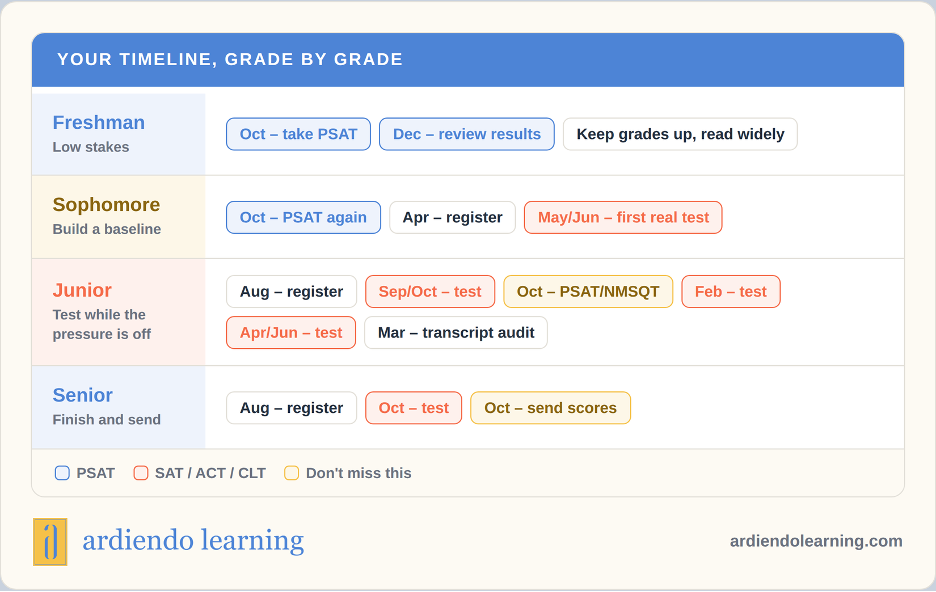
Grade-by-Grade Suggested Timelines
Freshman Year
There is nothing urgent that needs to be done in this year. Getting used to high school is part of the journey and your priority this year. If your school offers it, take the October PSAT and look at your score report (often released in December). Keep your grades up and try to find a genre you genuinely enjoy reading. (Parents: I recommend exploring the genres they enjoy in movies and finding a grade-level reading equivalent. The internet can be a very helpful resource to understand whether it is an appropriate and interesting read).
Sophomore Year
Take the PSAT in October and review your results. If you haven’t improved between Freshman and Sophomore year, that’s okay! It can be helpful to look into which areas you found challenging and seek the appropriate support. If you can, take an official ACT or SAT in the Spring.
Junior Year
The goal for junior year is simple: Prepare for and take a few official tests while the pressure is still off. Test in the Fall, look honestly at what happened, and go back in the Winter or Spring with a specific plan for improvements.
One date to keep in mind is the PSAT in October of Junior year, which is the version that qualifies for the National Merit Scholarship Program. Unlike the previous two years, this one is worth preparing for.
We hope this schedule allows you to approach your Senior year with results you are proud of instead of facing a last-minute realization of the stakes involved. Attempting to secure a major score jump in a short timeframe while simultaneously juggling applications and essays often leads to unnecessary stress. By choosing to prep purposefully and early, you give yourself the time needed for genuine growth, ensuring you enter Senior year feeling both capable and ready to focus on the next chapter of your learning journey.
How to Get Started
Take a diagnostic of each test.
Take one full-length, timed practice test of each, the ACT and SAT, with no phone and no breaks (if possible). This practice test provides you with your baseline score. If you can take a real test in an actual testing environment, I recommend that option.
Pick your test (see this article if you don’t know how to do that).
You can compare the two scores using our Score Converter to investigate which test is best for you. If the concordance scores are similar, you can choose the one that feels better to you.
Pick the right date to prepare for.
Once you’ve picked the test date, register for the test as soon as it opens. This way, you know you have to work towards a specific goal and remain accountable for studying.
Build the plan. Now that you know your starting score, your test, your goal, and your deadline, the plan mostly writes itself. You work on the sections with the most room to grow, take full-timed tests periodically to see if you’re making progress, review every wrong answer rather than just counting them, and review every right answer to see what you understand.
Where to Start
If you know your test, your goal, and your date, then you are ready to start prepping. Build your plan and protect that time. (It’s harder than it looks! You can use this Study Plan Builder to help you get started.)
If you do not know those yet, start with the diagnostic (step 1 above). It takes one Saturday morning, and it answers most of the other questions for you.
And if you would like help reading your results or building a timeline that fits your schedule, we would be happy to talk. Our initial consultations are always free, and we are here to help create a customized test prep plan that fits your student’s individual needs and goals.
Sources
Sanchez, E. I. (2023). A Compendium of ACT Test Preparation Research 2014–2021. ACT, Inc. — https://www.act.org/content/dam/act/unsecured/documents/R2320-A-Compendium-ACT-Test-Preparation-Research-10-2023.pdf
Sanchez, E. I., & Moore, R. (2020). What Preparation Works to Improve ACT Scores? ACT Research & Policy, Technical Brief, November 2020. ACT, Inc. — https://www.act.org/content/dam/act/unsecured/documents/R1756-preparing-for-college-admissions-tests-2020-11.pdf
College Board. How much time should my child study on Official SAT Practice? SAT Suite of Assessments. — https://satsuite.collegeboard.org/help-center/how-much-time-should-my-child-study-official-sat-practice